Federal Reserve Board Seeks Comment on "Skinny" Master Account/Payment Account Prototype
The Federal Reserve Board (the Board) has issued a Request for Information and Comment (RFI) on the development of a special purpose Reserve Bank account prototype, being referred to colloquially as a "skinny master account" or "Payment Account," which would enable eligible institutions to directly facilitate clearing and settlement activities for their own payment transactions with the Federal Reserve Banks. Comments on the proposal are due February 6, 2026.
Under the proposal, which the Board believes will be beneficial to those institutions engaged in innovative payments activities, a Payment Account would hold limited overnight balances of an eligible institution expressly for clearing and settling the institution's payments. Payment Accounts would be separate and distinct from a Reserve Bank master account (Master Account), and institutions generally would only be able to maintain one account with a Reserve Bank (either a Payment Account or a Master Account).
Institutions that satisfy the requirements for an account under the Federal Reserve Act would be eligible to request a Payment Account from the relevant Reserve Bank, which would be approved or denied in that Reserve Bank's discretion. The RFI anticipates that Payment Account requests would be reviewed in a relatively streamlined process, within 90 calendar days from the Reserve Bank receiving all necessary documentation.
The chart below outlines which services would and would not be available to Payment Account holders:
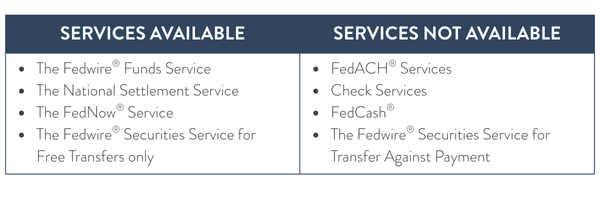
Payments from a Payment Account would necessarily need to be prefunded, as outgoing transactions that would result in an overdraft in the Payment Account would be rejected. Payment Account holders would not have access to intraday credit (also known as daylight overdraft) when an institution's Federal Reserve account is in the negative during the business day. Balances held at the close of business are solely intended to provide liquidity for payment activity at the beginning of the next business day, and Payment Account holders would not receive interest on balances held overnight.
To assist its development of the Payment Account prototype, the Board is seeking responses to the following questions, among others:
- Would the design of the Payment Account prototype support payment activities of eligible institutions?
- What payment activities or use cases would a Payment Account best facilitate, or be unable to facilitate?
- How might the Board condition access to a Payment Account on the applicant having an acceptable anti-money laundering (AML), Bank Secrecy Act (BSA) and Countering the Financing of Terrorism (CFT) compliance programs? More generally, how can the Board best constrain AML/BSA/CFT risks associated with a Payment Account?
Stinson LLP attorneys are closely monitoring the Payment Account proposal as well as other federal and state developments to aid nonbank/Fintech companies seeking enhanced access to the U.S. banking and payment systems. For more information on the Payment Account proposal, please contact Heidi Wicker, Matthew Grimaldi, or the Stinson LLP contact with whom you regularly work.